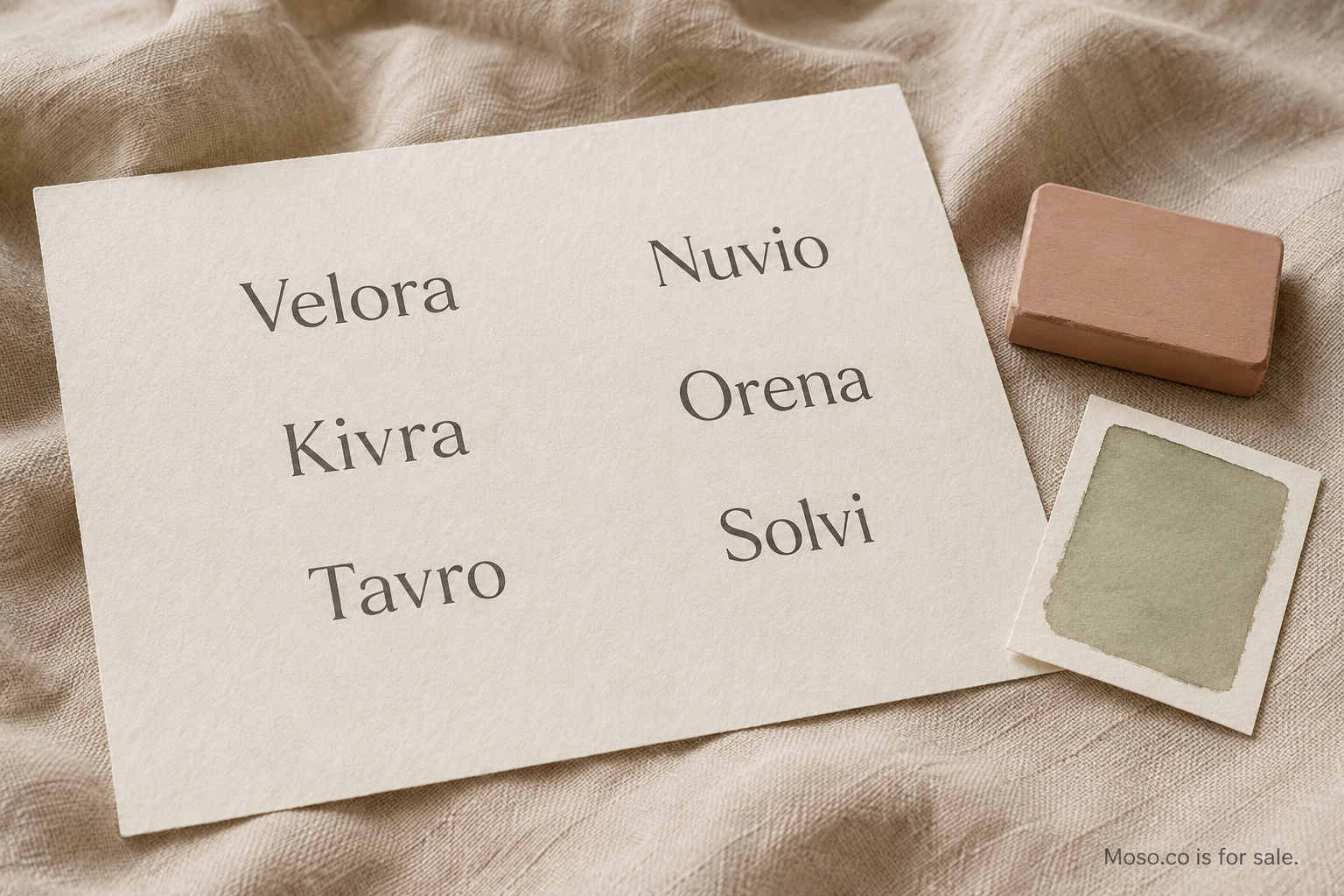
An invented brand name starts with almost no dictionary claim on the product. A category label starts with a claim so complete that competitors can repeat it tomorrow. That is the core trade. Descriptive names explain. Coined names can be owned. Companies that expect to live longer than their first offer often need the second kind of power more than they need the first day's clarity.
Inkbot Design's survey of brand naming conventions walks through the familiar spectrum: fanciful or coined, arbitrary, suggestive, and descriptive. The further you move toward description, the easier the first conversation becomes and the harder distinctiveness becomes. The further you move toward invention, the more work the launch has to do and the more exclusive the mark can be if people can actually say it.
What a category label costs later
Category labels feel responsible at the start. They tell the customer what to buy. They also age with the catalog. A company named for one service adds a second service and suddenly the name is a lie or a constraint. Teams then invent a house brand on top of the descriptive one, which means they paid for explanation and still had to build identity.
Shopify's guide on how to name your brand keeps returning to future use. A name should still make sense when the product line is no longer the original sketch. Invented names are not automatically future-proof. They are simply not tied to a feature list. That freedom is the commercial reason to accept the extra teaching at launch.
Category language is also crowded. If the honest words for the offer are the same words every competitor uses, the label will not travel as a mark. It will travel as a search phrase that you do not own. Paid acquisition can rent those words. A brand still needs something people can say when the ad is gone.
What invented names have to earn
A coined mark is not a shortcut around craft. It has to be pronounceable. It has to be spellable. It has to pass a radio test. Identity Makers' brand naming guide is blunt about invented words that look original on a slide and collapse in speech. If the team cannot say the name without smiling at their own cleverness, customers will not say it at all.
Empty-vessel explainers such as The Toolbox piece on how to name a brand are useful here. An empty vessel is a name with little prior meaning. That emptiness is an asset only if the company will actually pour meaning in: product quality, a clear offer, a consistent voice, and enough repetition for the word to start meaning something. An invented name with no operating plan is a blank box in a warehouse.
I have a bias toward two-syllable coined words with open vowels. They tend to survive introductions. They set cleanly. They leave room for a tagline to do the explaining that the name refuses to do. Longer neologisms can work. They ask more of every sentence. Category phrases ask less of the first sentence and more of every year after that.
When a descriptive name is still the right call
Honesty requires the other side. A local service with one offer and no plan to expand may be better served by a clear descriptive name. A regulated category may need the customer to understand the service before they understand the brand. Invention is not a moral improvement. It is a strategic fit for companies that need ownability more than instant explanation.
The test is the three-year catalog. If the company will still be the thing the label names, description can be efficient. If the company is likely to add adjacent products, enter new channels, or become a house over several offers, a category label will start to pinch. Invented names pinch less. They demand more teaching. That is a fair trade when the teaching budget exists.
Legal distinctiveness follows the same slope. Fanciful and arbitrary marks are easier to protect as marks because they do not describe the goods. Descriptive terms can be harder to claim. None of that replaces counsel. It does explain why naming teams keep reaching for coined words when the business is meant to become a brand rather than a listing.
How to choose invention without becoming obscure
Write the offer in plain language first. Then invent a name that can sit beside that sentence, not instead of it. Pair the coined word with a tagline or a short descriptor on the first encounters. Test speech before you test logos. Search for collisions. Keep the spelling ordinary even if the word is new. A coined name with a familiar phonetic pattern beats a coined name that looks like a password.
Invented brand names beat category labels when the company needs a mark it can keep as the work changes. They lose when the team wanted a shortcut around positioning. The name will not explain the business. The business has to explain the name, once, clearly, and then stop apologizing for it. After that, repetition and conduct do the patient work that a descriptive label was trying to skip.
There is a cultural reason as well. Category labels invite comparison shopping. Invented names invite a relationship with a specific company. That does not make invented names kinder or more artistic. It makes them better at holding reputation. When something goes well, the coined word can keep the credit. When a category label goes well, the credit leaks into the generic term everyone else is using.
I tell teams to keep a parallel file: the invented name on one line, the plain-language offer on the next. If they cannot write the second line, they are asking the first line to do two jobs. That is how coined names become obscure. The invention should replace the label as a mark, not as an explanation. Keep the explanation. Change only the thing people will repeat when they mean you.
Portmanteaus and compounds sit in the middle of this argument. They can hint without describing. They can also look clever and age quickly. I would rather a clean coined word with a living sentence beside it than a mashup that tries to smuggle the category into the letters. The letters should be easy. The sentence should be true. That pairing is how invented names beat category labels without disappearing into fog.